Why Brake Pads Matter More Around Here
Brake pads are a wear item — every set has a finite life. But that life varies enormously with where you drive. The Northern Beaches and Lower North Shore are genuinely hard on brakes: steep descents like Fairlight Heights and the drops down to Balmoral, stop-start crawls on Military Road and Pittwater Road, and wet winter mornings all accelerate pad wear. Hilly-suburb cars can wear front pads 20–30% faster than the same car driven on flat ground.
The good news: pads almost always warn you before they become dangerous. Here's what to look and listen for.
5 Warning Signs Your Brake Pads Are Worn
1. Squealing or Screeching When You Brake
Most pads have a built-in metal wear indicator — a small tab designed to contact the rotor and squeal when the pad material gets low. If you hear a high-pitched screech every time you brake (especially first thing in the morning), that's the pad telling you it's due.
2. Grinding — Stop Driving
A deep metal-on-metal grinding means the pad material is gone and the steel backing plate is chewing into the rotor. Every kilometre driven like this turns a cheap pad replacement into an expensive pad-plus-rotor job — and your stopping distance is badly compromised. Park the car and get it looked at.
3. Longer Stopping Distances or a "Spongy" Pedal
If the car takes noticeably longer to pull up at the Spit Bridge lights than it used to, or the pedal travels further before biting, the pads (or the brake fluid) need attention.
4. The Car Pulls to One Side When Braking
Uneven pad wear or a sticking caliper makes the car tug left or right under brakes. It often shows up on steep descents — exactly where you want your brakes working evenly.
5. Vibration or Pulsing Through the Pedal
A pulsing brake pedal usually points to warped rotors — common after heavy braking on long descents. Pads and rotors get assessed together.
The 2-Minute Visual Check
On most cars you can check the front pads without removing the wheel:
- Park on flat ground and turn the steering full-lock to one side — this opens up the view through the wheel spokes.
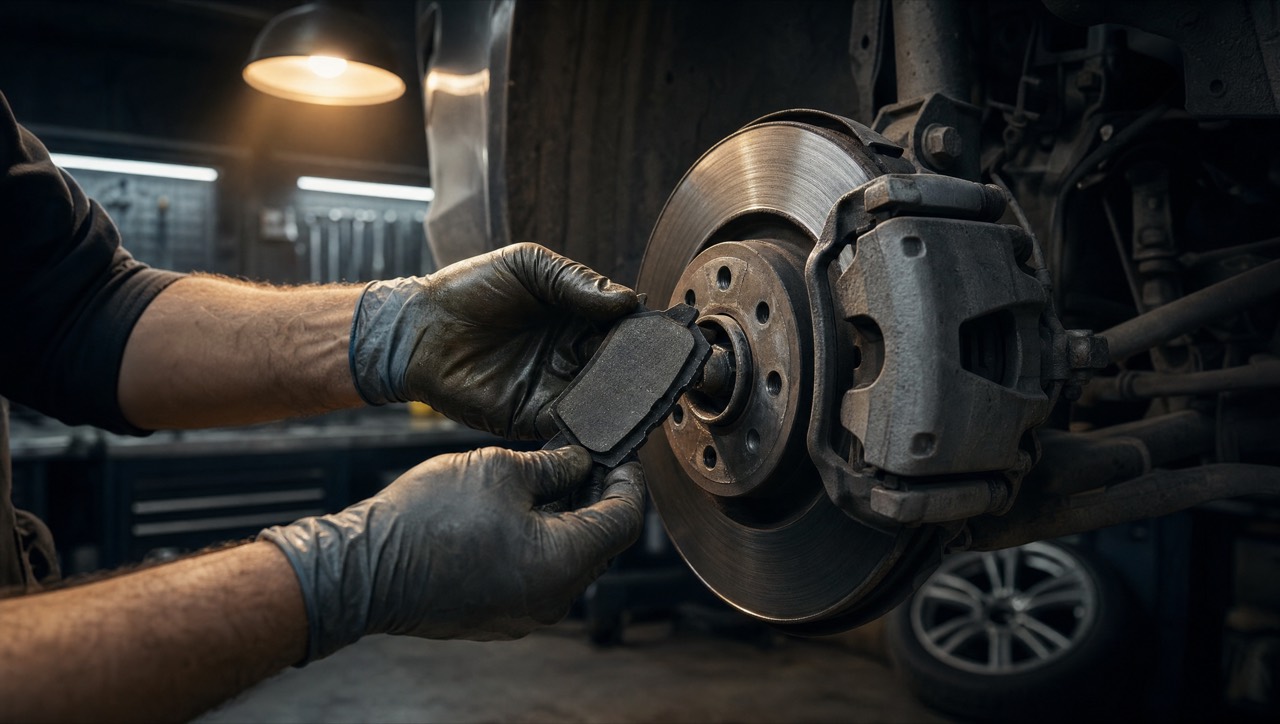
- Look through the spokes at the brake caliper (the metal clamp sitting over the shiny disc). The pad is sandwiched between the caliper and the disc.
- Check the pad thickness — you're looking at the pad's edge. New pads are around 10–12 mm thick. If what you can see is 3 mm or less (about two stacked $1 coins), it's replacement time.
- Check the disc surface while you're there — deep grooves or a pronounced lip at the outer edge mean the rotors are wearing too.
Can't see through your wheels, or not sure what you're looking at? Take a photo through the spokes and send it to us — we'll tell you honestly whether it's urgent.
How Long Do Brake Pads Last?
Anywhere from 25,000 to 70,000 km depending on the car, the pads, and the driving. City and hill driving sits at the low end; freeway kilometres at the high end. As a rule of thumb on the Beaches: have them inspected at every service, and budget for fronts roughly twice as often as rears.
When to Call a Mechanic
Brakes are not a "wait and see" system. Call a professional if you notice grinding, pulling, pulsing, a soft pedal, or pads at 3 mm or less. The mobile advantage: Pro Tune replaces pads and machines or replaces rotors at your home or workplace — anywhere from Palm Beach to Chatswood — with an itemised quote approved by you before any work starts. No call-out fees, and the car never has to limp to a workshop on worn brakes.